February 26–27, 2027 · Clearwater, FL · 16 CE Credits
The 2-Day Agenda
Sixteen hours of CE — paced so a practicing dentist can absorb every protocol and walk back into the office Monday morning ready to use it.
The Heart of This Presentation
Higher profitability through simpler, more predictable clinical protocols.
The presentation focuses on practical, repeatable clinical protocols for restorative and cosmetic cases. Full-arch and single-unit workflows are taught through the same organized diagnostic, preparation, provisional, laboratory, and delivery framework. The program favors straightforward techniques and does not require expensive proprietary equipment. Attendees receive the complete lecture outline in PDF format so they can revisit each protocol and adapt it to their own clinical judgment, patient needs, and practice setting.
— From the 2027 seminar brochure
The Cases You'll Take Home
Study an organized protocol for each case type below.
Each card is a clinical area you'll work on live in Clearwater — pulled from cases Drs. Strupp and Brumm have treated in their Clearwater operatories. These are the case types discussed in the program.
Tap any case to enlarge.
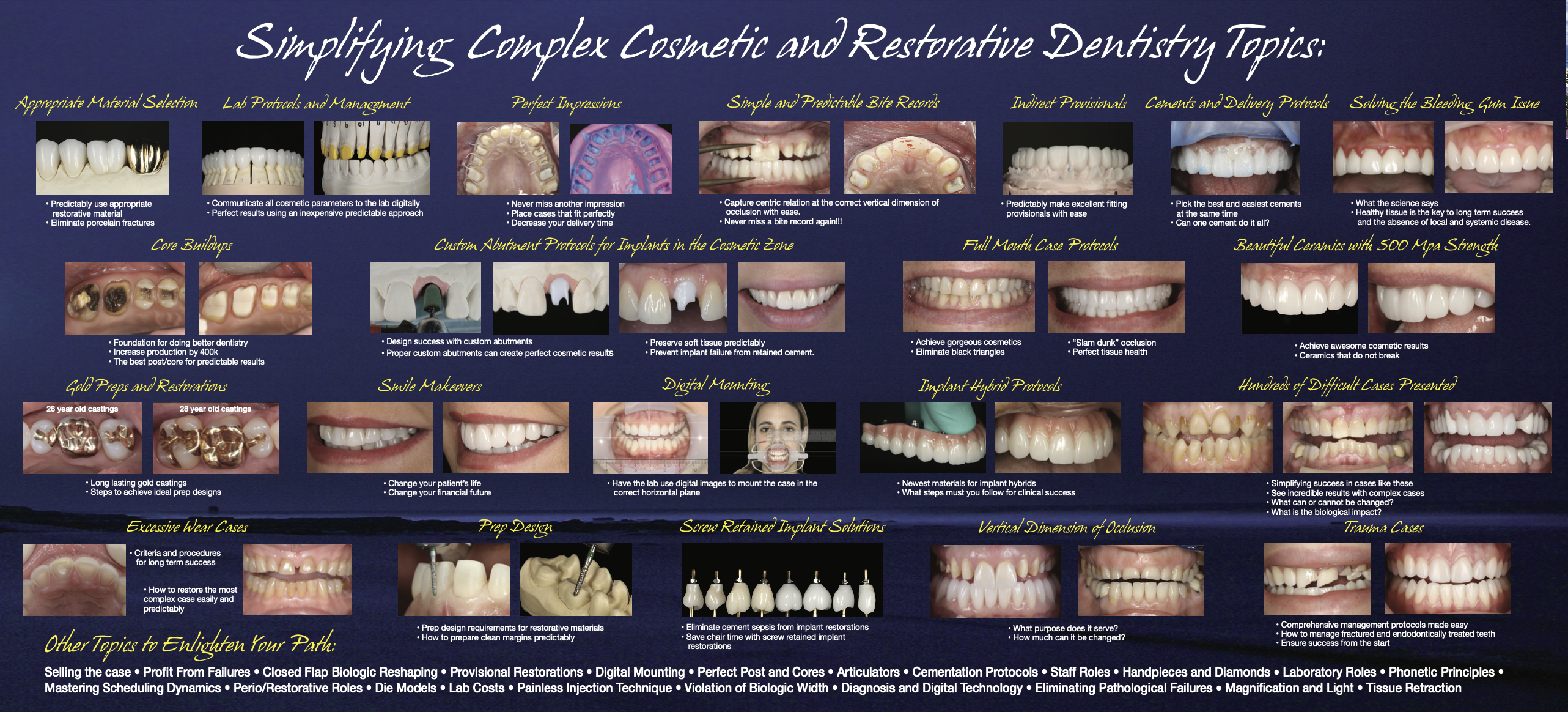
The Full Poster
Every topic on a single page.
The complete curriculum poster from the 2027 brochure — every clinical case, every protocol, in one visual.
“Hands down one of the most in-depth and inspiring full-arch courses.”
21 Named Topics
Every protocol on the curriculum poster — by name.
The full topic list from the 2027 brochure. Each one is taught live with case documentation in the two-day program.
Topic 01
Appropriate Material Selection
- Predictably use appropriate restorative material
- Reduce avoidable porcelain fracture risk
Topic 02
Lab Protocols & Management
- Communicate all cosmetic parameters to the lab digitally
- Improve consistency using a practical approach
Topic 03
Impression Protocols
- Reduce impression errors and retakes
- Improve fit through a repeatable capture protocol
- Decrease your delivery time
Topic 04
Simple & Predictable Bite Records
- Capture centric relation at the correct vertical dimension of occlusion with ease
- Improve bite-record consistency
Topic 05
Indirect Provisionals
- Predictably make excellent-fitting provisionals with ease
Topic 06
Cements & Delivery Protocols
- Pick the best and easiest cements at the same time
- Can one cement do it all?
Topic 07
Solving the Bleeding-Gum Issue
- What the science actually says
- Healthy tissue is the key to long-term success — and the absence of local and systemic disease
Topic 08
Core Buildups
- Foundation for doing better dentistry
- Build a more efficient core-buildup workflow
- The best post/core for predictable results
Topic 09
Custom Abutment Protocols (Implants in the Cosmetic Zone)
- Design success with custom abutments
- Proper custom abutments create perfect cosmetic results
- Preserve soft tissue predictably
- Prevent implant failure from retained cement
Topic 10
Full-Mouth Case Protocols
- Achieve gorgeous cosmetics
- Eliminate black triangles
- Occlusal design and verification
- Support healthy tissue contours
Topic 11
Beautiful Ceramics with 500 MPa Strength
- Plan cosmetic ceramic cases
- Material selection and design for fracture resistance
Topic 12
Gold Preps & Restorations
- 30+ year-old castings shown live
- Long-lasting gold castings
- Steps to achieve ideal prep designs
Topic 13
Smile Makeovers
- Change your patient's life
- Integrate smile-makeover cases into your practice
Topic 14
Digital Mounting
- Have the lab use digital images to mount the case in the correct horizontal plane
Topic 15
Implant Hybrid Protocols
- Newest materials for implant hybrids
- What steps you must follow for clinical success
Topic 16
Hundreds of Difficult Cases Presented
- Simplifying success in cases like these
- See incredible results with complex cases
- What can — or cannot — be changed?
- What is the biological impact?
Topic 17
Excessive Wear Cases
- Criteria and procedures for long-term success
- A structured workflow for complex cases
Topic 18
Prep Design
- Prep design requirements for restorative materials
- How to prepare clean margins predictably
Topic 19
Screw-Retained Implant Solutions
- Reduce risk from excess cement around implant restorations
- Save chair time with screw-retained implant restorations
Topic 20
Vertical Dimension of Occlusion
- What purpose does it serve?
- How much can it be changed?
Topic 21
Trauma Cases
- Comprehensive management protocols made easy
- How to manage fractured and endodontically treated teeth
- Plan key decisions from the start
Other Topics to Enlighten Your Path
Selling the case · Profit from failures · Closed-flap biologic reshaping · Provisional restorations · Digital mounting · Post and core protocols · Articulators · Cementation protocols · Staff roles · Handpieces and diamonds · Laboratory roles · Phonetic principles · Mastering scheduling dynamics · Perio / restorative roles · Die models · Lab costs · Painless injection technique · Violation of biologic width · Diagnosis and digital technology · Analyzing pathological failures · Magnification and light · Tissue retraction
Day One
The full restorative workflow — diagnosis through delivery, plus implants
7:00 – 8:30 AM
Registration, breakfast & introductions
8:30 – 9:15 AM
Diagnostic records & treatment planning
The unified diagnostic protocol used in the Strupp/Brumm office on every cosmetic and restorative case: photographic series, mounted models, smile design analysis, and periodontal and occlusal screening.
9:15 – 10:00 AM
Case planning & patient presentation
The case-planning conversation, the same checklist Dr. Strupp uses on every new patient, and the language to present complex treatment without overwhelming the patient.
10:00 – 10:45 AM
Core buildups
Core material decisions and predictable buildups that hold up under final restorations on every tooth in the arch — including the molars most dentists are nervous about.
10:45 – 11:30 AM
Posts, cores & ferrule management
The post-and-core protocol from the Dentistry Today cover article: material selection (fiber post, cast post, or no post), ferrule management, and how to know when a tooth is restorable versus when to extract and implant.
11:30 AM – 12:15 PM
Preparations & material-specific design
Ideal prep design, reduction depths, and margin placement tailored to pressed ceramics, lithium disilicate, gold, and bonded composite. Bur sequences, finishing protocols, and conservative tissue management throughout.
12:15 – 12:45 PM
Lunch
12:45 – 1:30 PM
Final impressions
Final impressions (digital and analog), the details that determine how cleanly a case seats, and the photographs and records the laboratory needs to finish the case.
1:30 – 2:15 PM
Bite records & provisionals
Bite records that don't shift on the articulator, plus the jet-acrylic provisional workflow, contour for tissue health, occlusal and aesthetic try-in, and patient comfort between appointments.
2:15 – 3:00 PM
Lab communication
What the lab actually needs to give you back what you planned — stump shades, custom shade matching, photographs, and the prescription details most dentists skip.
3:00 – 3:45 PM
Try-in & final delivery
The try-in and final delivery protocol: cementation choices by material, isolation, occlusal verification, and what to do when something doesn't fit on insertion day.
3:45 – 4:30 PM
Implants — single unit to full-arch hybrids
Restorative protocols across the full implant spectrum — single-tooth restorations in the cosmetic zone, multi-unit posterior bridges, and full-arch hybrid prostheses (All-on-X, screw vs cement-retained, fixed/removable). Decision trees for surgical sequencing, prosthetic transition timelines, and the impressions and records that make hybrid arches predictable.
4:30 – 5:00 PM
Structured case review — bring your cases
Faculty-led review of attendee cases focused on diagnostic records, treatment sequencing, and restorative planning. Bring mounted models, study casts, photographs, or intraoral scans.
Day Two
Occlusion, full-arch protocols & biologic shaping
8:30 – 9:15 AM
Day One review & Q&A
9:15 – 10:00 AM
Occlusion — CR–CO fundamentals
The simplest explanation of CR–CO you will hear all year, including when to leave the bite alone, when to equilibrate, and the diagnostic findings that tell you which path the case is on.
10:00 – 10:45 AM
Occlusion — VDO & bite records
When to open vertical, the rules for doing it without ending up in TMJ trouble or remakes, and the bite-record protocols that make full-mouth cases predictable on the articulator.
10:45 – 11:30 AM
Full-arch protocols — diagnosis & sequencing
Natural-tooth full-arch cases from the Strupp/Brumm office, walked through from diagnosis and sequencing to the real-time decisions that shaped each outcome.
11:30 AM – 12:15 PM
Full-arch protocols — preparation to seat
Prep design across an entire arch, provisional fabrication, occlusal verification, and the seat appointment, illustrated with documented cases.
12:15 – 12:45 PM
Lunch
12:45 – 1:30 PM
Full-arch protocols — hybrid & combination cases
Hybrid and combination full-arch cases, including the diagnostic findings that point toward implants over natural teeth and the protocols for combining the two arches in the same patient.
1:30 – 2:15 PM
Full-arch protocols — failures & remakes
Failures, remakes, and the lessons that change how you plan the next full-arch case.
2:15 – 3:00 PM
Biologic shaping — diagnosis
How crown lengthening, gingival contouring, and biologic-width violations show up in restorative work.
3:00 – 3:45 PM
Biologic shaping — tissue management
Protocols for soft-tissue management in your own office or with a periodontal partner — the detail that quietly determines whether a beautiful case still looks beautiful in five years.
3:45 – 4:30 PM
Q&A, certificates & next steps
4:30 – 5:00 PM
Structured case review — final session
Faculty-led review of remaining attendee cases focused on diagnostic findings, treatment options, and sequencing. Bring models, photographs, or intraoral scans.
5:00 – 6:00 PM
Cocktail hour with the doctors
Wind down the program with Dr. Strupp, Dr. Brumm, and your fellow attendees. Cocktails and hors d'oeuvres are included — companions welcome.
What's Included
Everything you need to apply it Monday morning.
Tuition includes the printed technique manual, every digital handout, full breakfast and lunch each day, the Saturday cocktail hour with the doctors, and your CE certificate.
- 16 hours of CE credit in lecture format — verify acceptance with your licensing authority
- The Strupp/Brumm Technique Manual ($397 value) — printed and on USB
- The complete Keynote presentation outline in PDF ($897 value) — note-taking unnecessary
- Painless Injection Technique manual + video module
- Diagnostic & treatment planning checklists used in the Strupp/Brumm office
- Prep design guide across pressed ceramics, lithium disilicate, gold, and bonded composite
- Intraoral scan capture & upload workflow checklist
- Full-mouth restoration sequencing protocol
- Live Q&A access with both doctors throughout the program
- Structured case-review time with Drs. Strupp and Brumm each day — bring your models, photos, or intraoral scans
- Full breakfast and lunch each day
- Cocktail hour with the doctors on Saturday after the course
- Certificate of completion for your licensing records